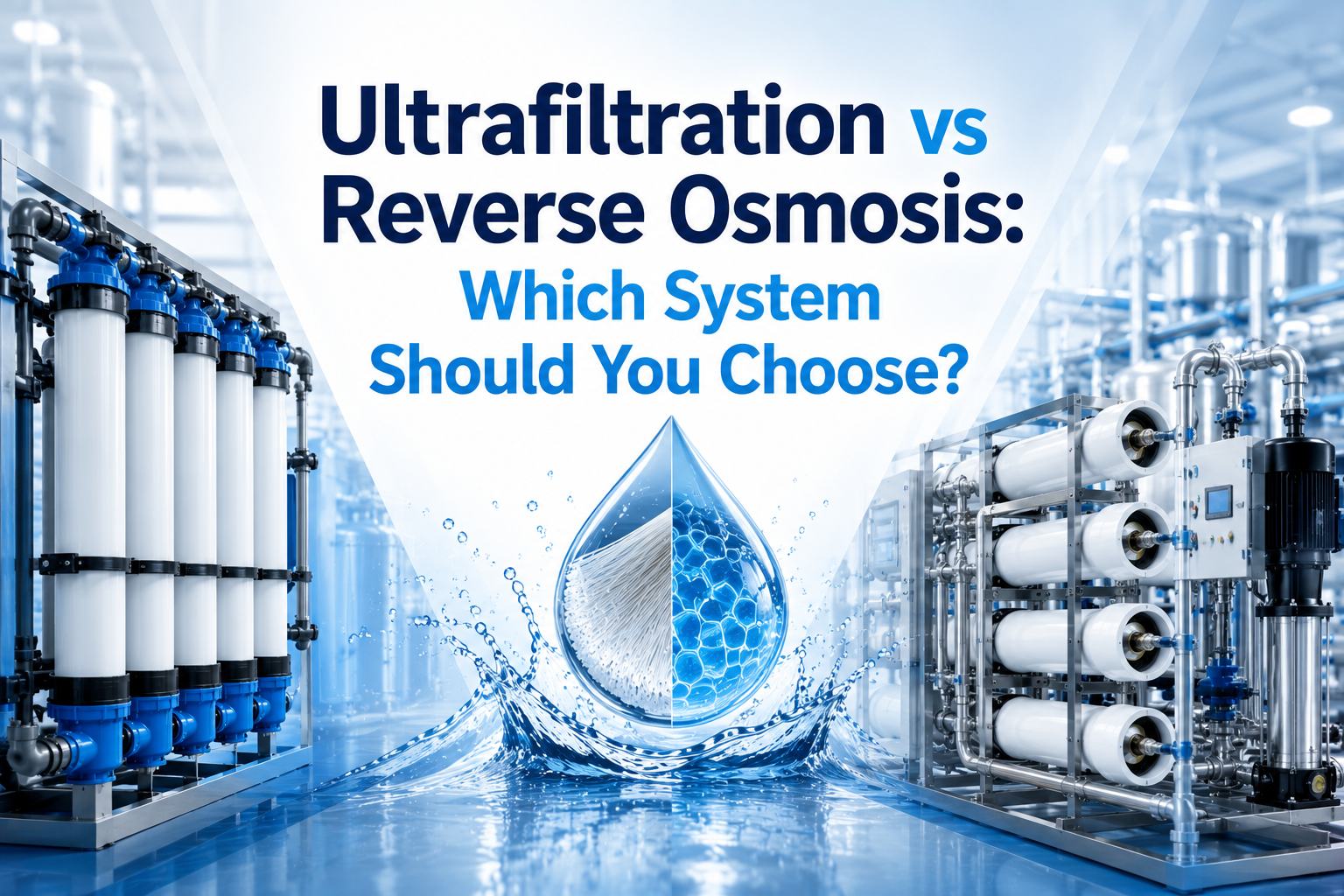
Ultrafiltration (UF) and reverse osmosis (RO) are both membrane-based water treatment technologies, but they serve different purposes. Understanding their differences is essential for selecting the right system for your industrial application.
Understanding the Technologies
- UF pore size: 0.01–0.1 microns
- RO pore size: ~0.0001 microns
- UF removes: suspended solids, bacteria, large organics
- RO removes: dissolved salts, minerals, organics
Key Differences
- Operating pressure: UF 0.5–2 bar vs RO 8–60 bar
- Energy consumption: UF lower, RO higher
- Water recovery: UF 90–95% vs RO 50–75%
- Membrane lifespan: UF 5–8 years vs RO 3–5 years
Application Suitability
- UF: pre-treatment for RO, drinking water, wastewater recycling
- RO: boiler feedwater, electronics, pharmaceutical, desalination
- UF as RO pre-treatment extends RO membrane life
- Combined UF+RO systems for high-purity applications
Selection Criteria
- Required permeate water quality
- Need for dissolved salt removal (RO) vs particle removal (UF)
- Energy and operating cost budget
- Available installation space
- Maintenance complexity tolerance
Engineering Note
UF membranes typically operate at 0.5–2 bar and reject particles down to 0.01 microns. RO membranes operate at 8–60 bar and reject dissolved salts. If your process only needs removal of suspended solids, bacteria, and large organics — UF is more energy-efficient. If you need dissolved salt removal, RO is required.
Summary
Key considerations when choosing between UF and RO:
- UF removes particles and bacteria; RO removes dissolved salts
- UF operates at lower pressure and energy
- RO achieves higher water purity
- UF can serve as pre-treatment for RO
The choice between UF and RO depends on your water quality requirements, budget, and application. In many cases, a combined UF+RO system provides the best overall performance and membrane longevity.